
Home › Photo Tours › Sicily’s Volcanoes & Calabria
Sicily’s Volcanoes & Calabria Photo Tour
Southern Italy is home to Europe’s most active volcanoes. Walking the slopes of Etna and Stromboli feels like exploring a primordial land, where the sound of footsteps sinking into black volcanic ash blends with the dull thud of the mountain’s inner pulse.
For centuries, one eruption after another has reshaped the landscape and the life it holds, shaping the communities that live on its flanks and enriching their stories, in a cyclical run of events that continues to this day.
And while Etna’s eruptions, frequent as they are, remain unpredictable, Stromboli’s mechanical regularity is a spectacle of its own. What by day looks like a column of dense smoke, not unlike a house chimney in winter, turns ancestral as the sun goes down. With darkness the explosions grow sharper, natural fireworks that light up the Stromboli night and keep pace with the stars as they cross the sky.
But Southern Italy is also a land woven with traditions and old crafts, where colourful stone villages look out over jagged coastlines and turquoise water. A mosaic that finds its fullest expression in the visual contrasts of Calabria. Here the Mediterranean light sets the geometries of Scilla alight, and the cliffs of Tropea dropping straight into the sea, then turns sharp and dramatic among the stone volumes of Pentedattilo, perched like a hand of rock. The real atmospheric reportage, though, hides in the woods of Serra San Bruno: here, among the shadows and the smoke of the scarazzi, the charcoal burners repeat gestures that are centuries old, offering timeless frames made of raw contrast, memory and hard labour.
Itinerary
Day 1 - Catania
We arrive in Catania in the morning, where the Mediterranean light already hints at what lies ahead. After picking up our vehicles, we make our way to our hotel in Catania for check-in, followed by a relaxed lunch and a short break. In the afternoon, we head south along the coast toward the Calanchi del Cannizzola, a landscape shaped by erosion and time.
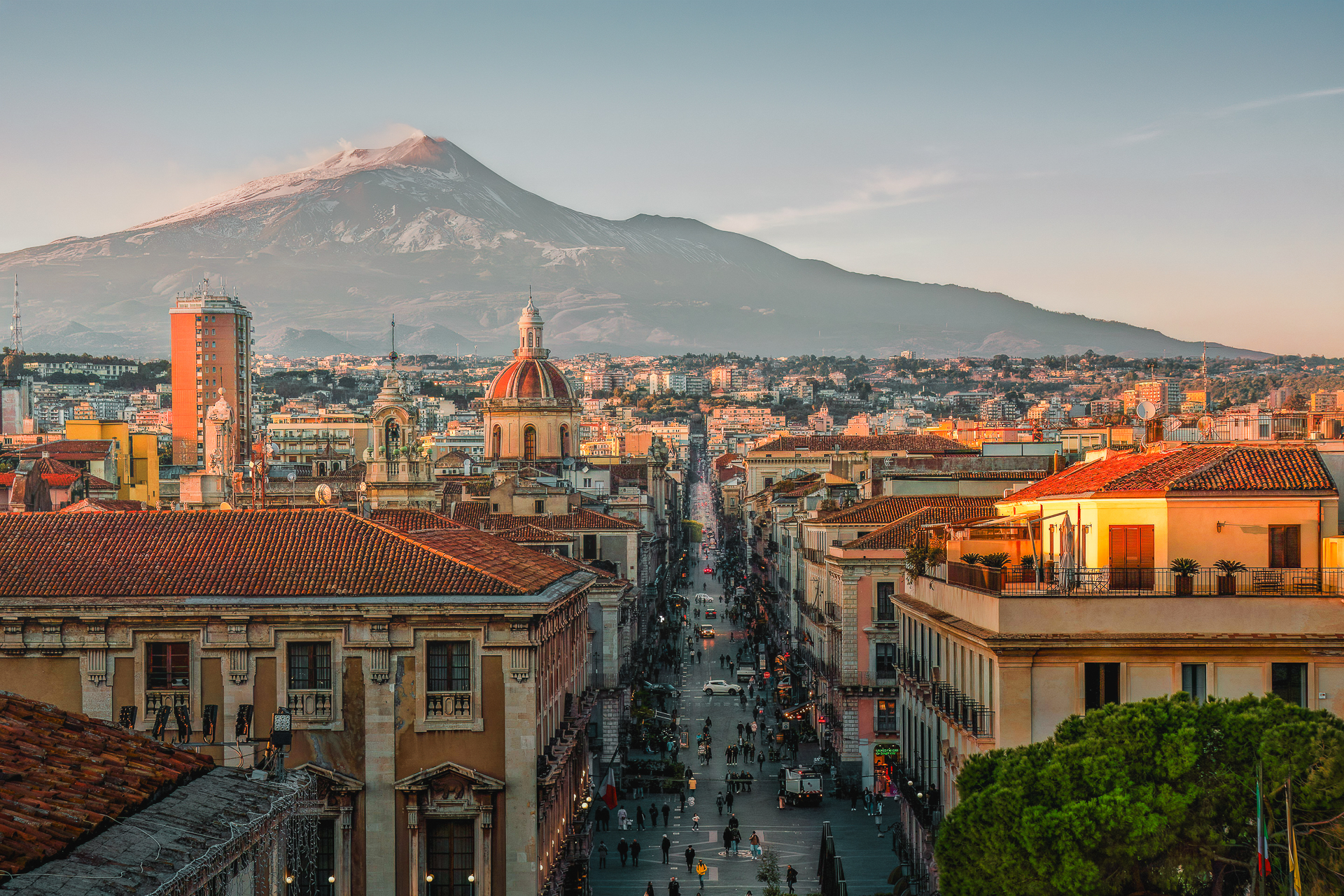
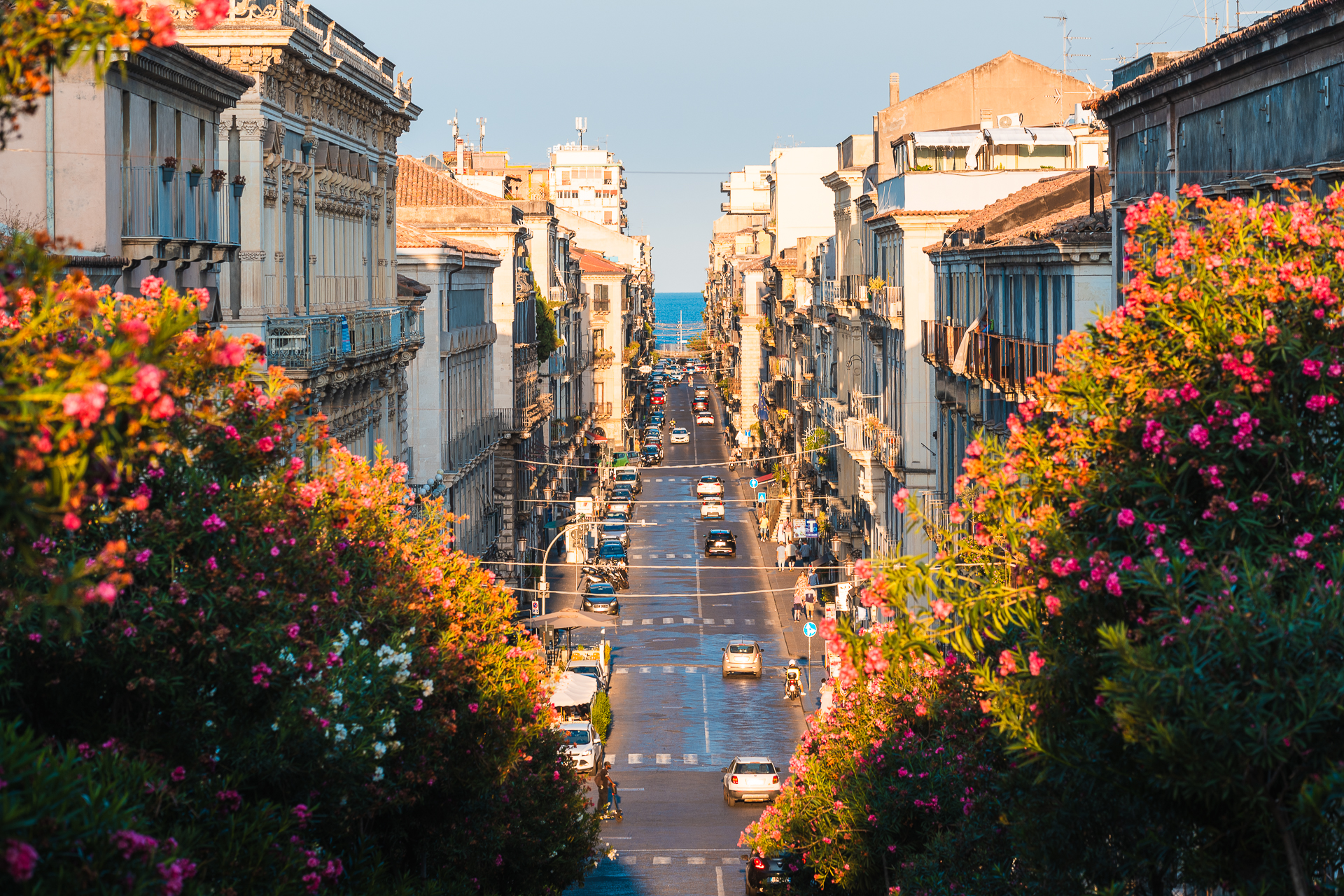
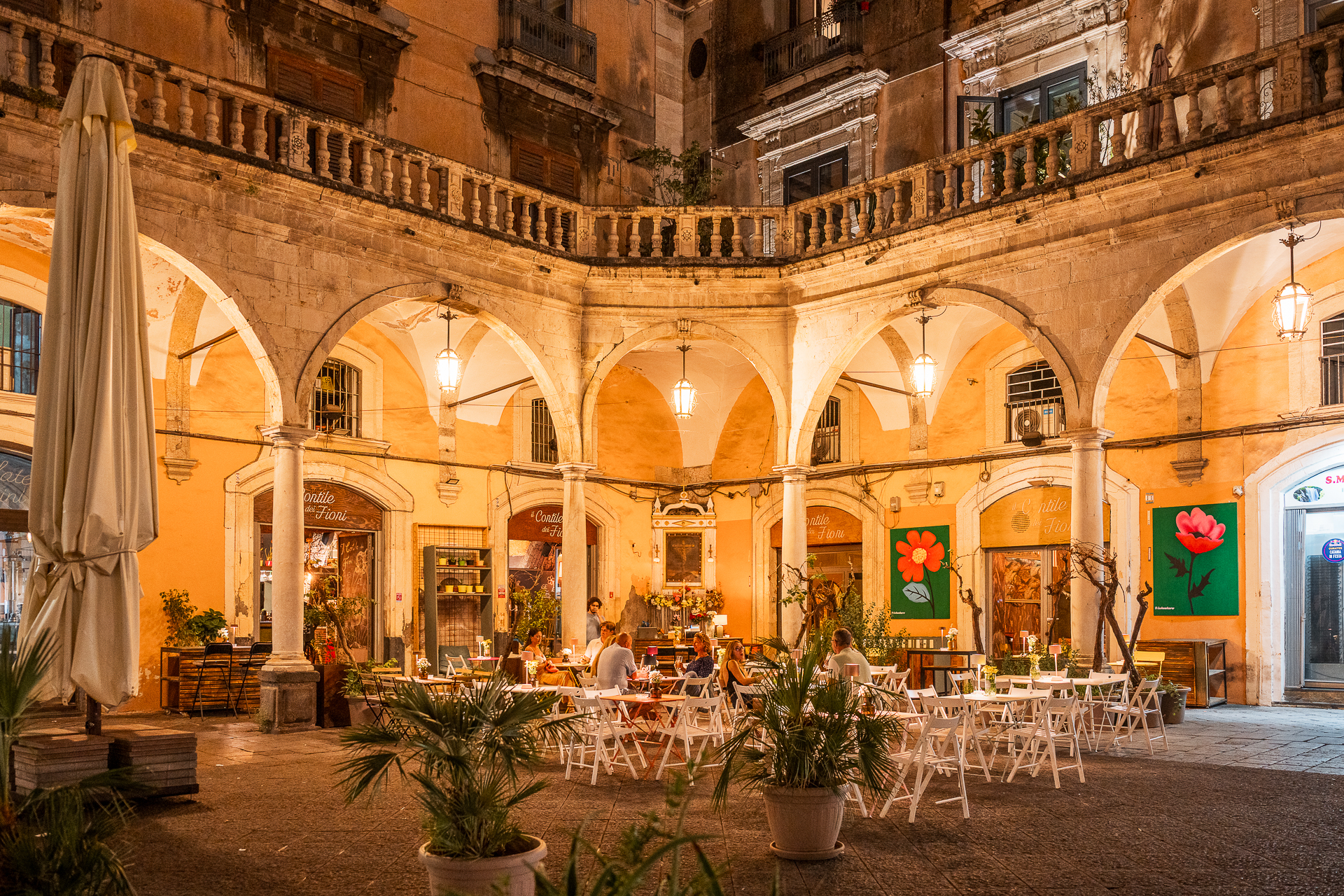
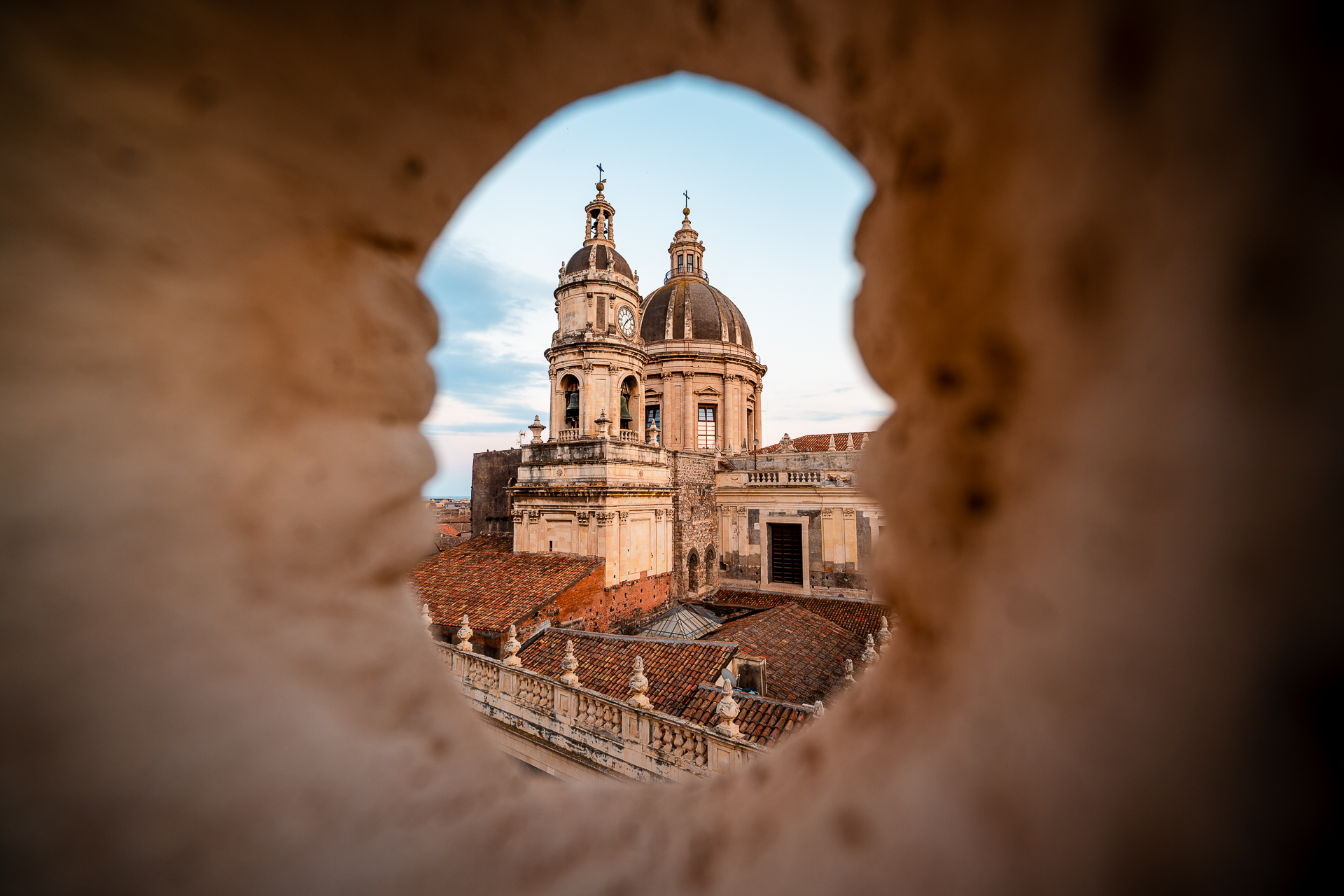
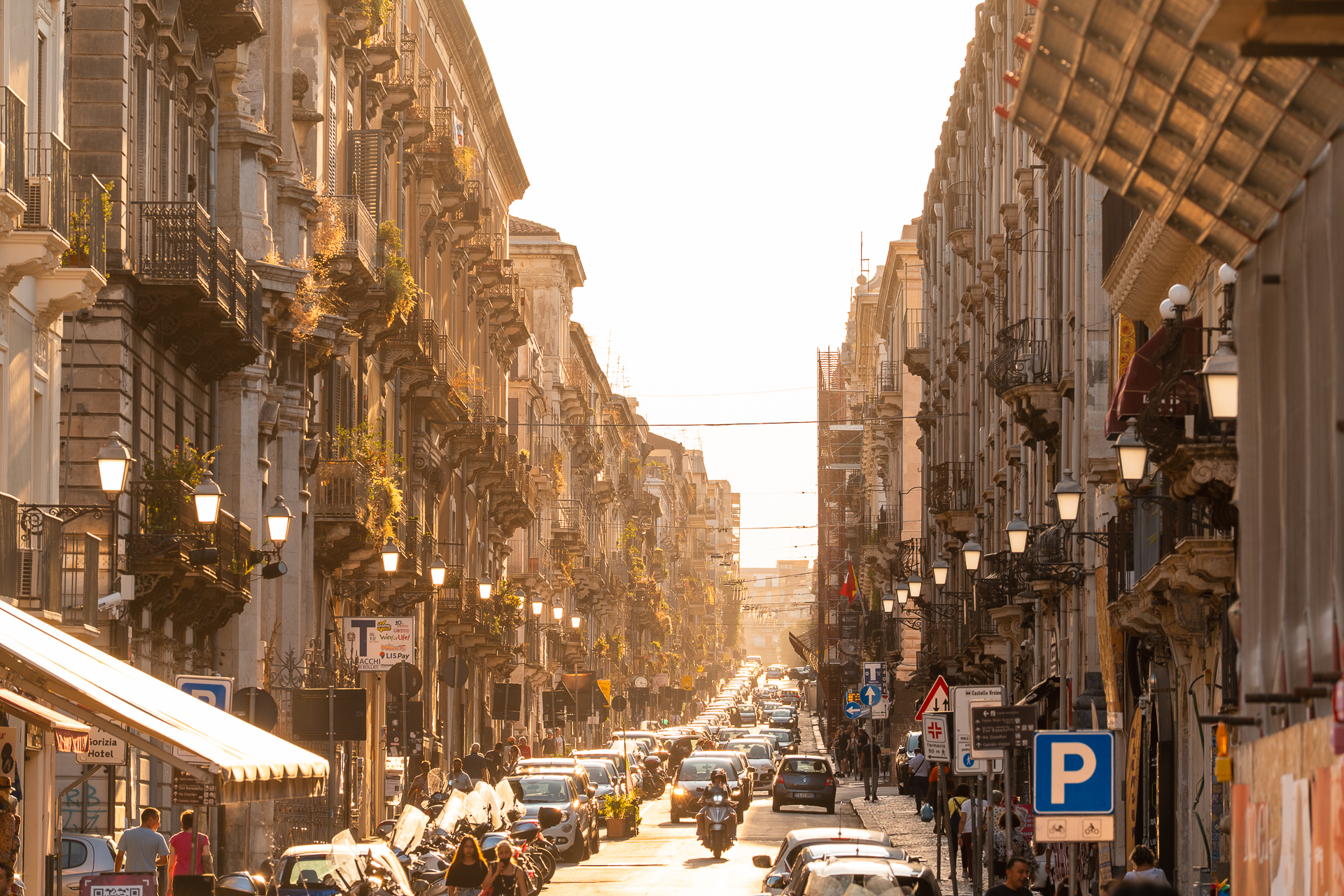
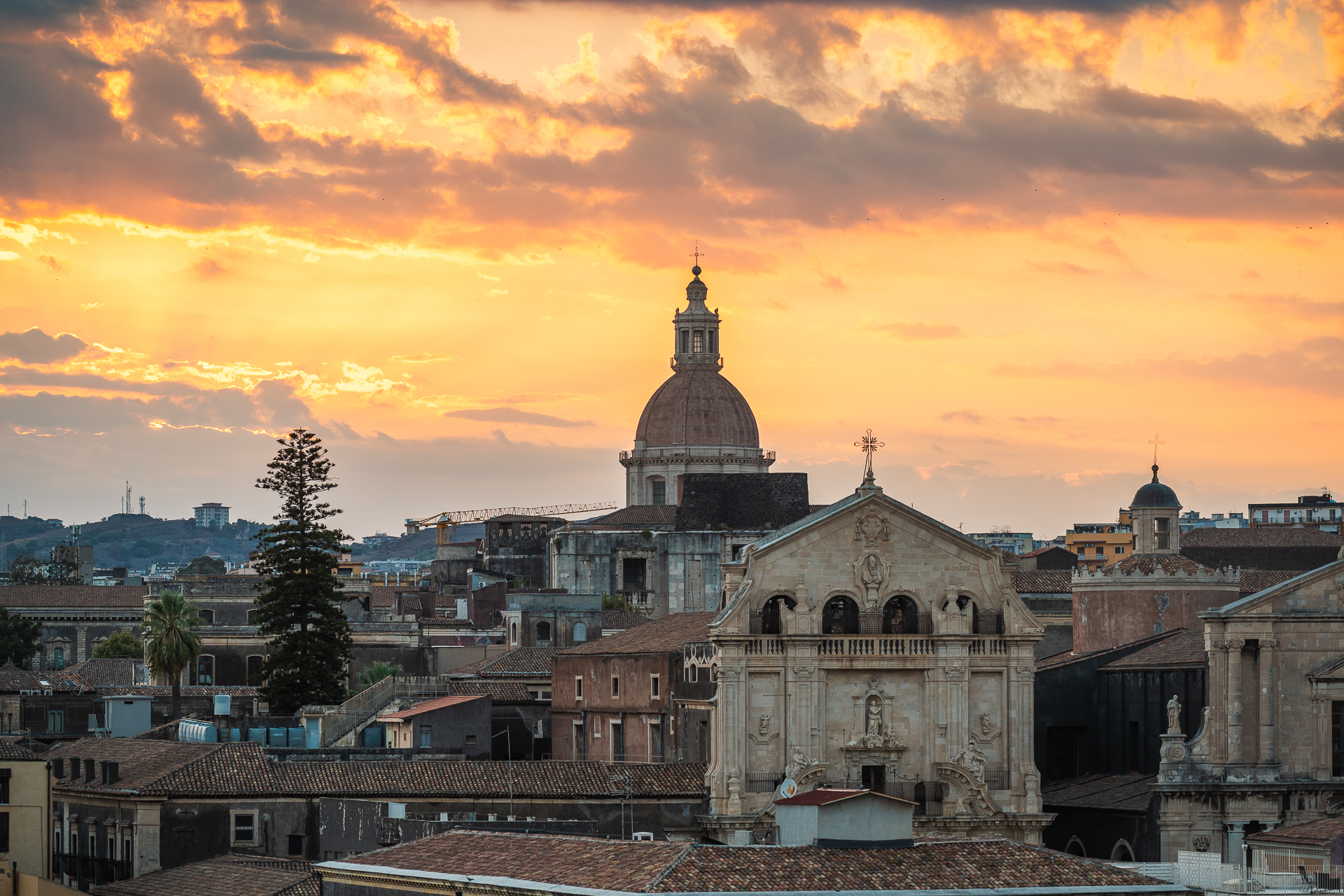
In the afternoon, we head into Catania’s historic centre for our first introduction to the city, exploring its lively streets, Baroque architecture, local markets and everyday life. As the afternoon light begins to soften, we move to an elevated viewpoint overlooking the rooftops and historic heart of Catania, with Mount Etna rising in the background. Here, we photograph the city through sunset, working with the changing light as the warm tones of the sky gradually give way to blue hour.
Overnight in Catania.
Day 2 - Mount Etna
For our first session at dawn we head to Isola Bella in Taormina, nicknamed the “Pearl of the Mediterranean”. A small rocky islet just off the Sicilian coast, known for its lush exotic and Mediterranean vegetation and joined to the mainland by a thin isthmus of white pebbles that appears and disappears with the tides. At sunrise the backlight gives the scene a fairytale quality, while the passing of a slow coastal train completes the storytelling of a first session that is simple and unhurried, yet capable of producing iconic images of one of the best-known landscapes on Sicily’s Ionian coast.
And little by little, Etna’s presence starts to become impossible to ignore for us too, dominating both the horizon and the imagination. Our adventure begins in the early afternoon: we reach the main car park and from there continue towards the higher altitudes. A cable car and 4×4 vehicles take us to the base of the summit craters, at almost 3,000 m. Waiting for sunset, accompanied by an expert volcanological guide, we cross a lunar landscape of recent lava formations and extinct craters, gaining a deeper understanding of the dynamics behind Etna’s activity and of what it means to live on its slopes.
As the light softens, we position ourselves to photograph the vastness of the volcanic plateau and the striking passage from day to night. Here sunset is not a single moment but a process: the colours slowly drain from the sky while the ground still holds the heat of the day. After dusk we begin the descent on foot, our torches lighting the ash beneath our steps and creating an almost surreal atmosphere.
Overnight in Catania.
* The Etna excursion is always led by an expert volcanological guide, ensuring maximum safety and a thorough knowledge of the terrain. The descent to the car park covers around 900 m of elevation loss, mostly over volcanic ash, which makes it similar to walking down an immense sand dune and requires high-ankle hiking boots. Although it presents no particular technical difficulty, the length of the route and the altitude make the excursion unsuitable for anyone with heart or knee problems. An alternative programme is available for those unable or unwilling to take part.
** Should Etna be erupting at the time of our excursion, an alternative location will be chosen together with our guide, in full compliance with the restrictions in force, so that the eruptive activity can be photographed in complete safety.


Day 3 - Aeolian islands
Before dawn, we head to Torre Santa Tecla, a historic square watchtower dating back to the 16th century, perched above the sea on the volcanic cliffs of Acireale. Looking more like a corner of Scotland than Sicily, this simple location will give us the opportunity to begin working with long exposures, strong backlight and the deep contrasts and colors typical of a volcanic landscape.
We return to the hotel for breakfast and check-out before heading toward Messina, where we board the hydrofoil that will take us into the Aeolian Islands. The journey to Lipari takes approximately two and a half hours, during which the silhouettes of the volcanic archipelago will slowly begin to emerge on the horizon.
Once we arrive in Lipari, the largest and most vibrant of the Aeolian Islands, we are welcomed by the vivid colors and unmistakable scents of the Mediterranean. After leaving our luggage at the hotel, we set out to explore the historic center, walking along the lively Corso Vittorio Emanuele to the picturesque seaside square of Marina Corta, animated by traditional fishing boats and outdoor cafés.
For sunset, we make our way to the island’s high cliffs, looking out toward the iconic sea stacks and the distant islands of Filicudi and Alicudi, the wildest and least populated of the Aeolian Islands. After the sun has disappeared beyond the horizon, we end the day with dinner in a traditional local restaurant, discovering the authentic flavors of Aeolian cuisine.
Overnight in Lipari.


Day 4 - Aeolian islands
Before dawn, we make our way to one of the most scenic viewpoints on the island, with a postcard view over the town of Lipari and the imposing silhouette of Vulcano rising in the background. On particularly clear mornings, even the distant outline of Mount Etna can appear on the horizon—the final touch to an already idyllic composition.
Later in the morning, we continue our journey toward Stromboli, the “Lighthouse of the Mediterranean,” an island with a raw and magnetic character. Arriving by hydrofoil immediately reveals the wild nature of this place: a near-perfect volcanic cone rising from the deep blue sea, with a plume of smoke almost constantly crowning its summit.
After checking into our hotel, we begin exploring the maze of narrow whitewashed streets of Stromboli village, with their unmistakable Aeolian character. There are no cars here, only small three-wheeled vehicles and Piaggio Apes moving through the village.
In the late afternoon, we meet our certified volcanological guide and begin the ascent toward the 400-meter viewpoint, following trails overlooking the Tyrrhenian Sea. Having a private guide allows us to manage the pace and stops according to our needs, whether to photograph along the way or simply catch our breath.
As dusk falls, we reach the viewpoint overlooking the Sciara del Fuoco, and the experience turns into a true photographic hunt. Surrounded by darkness, the volcano reveals its full power: accompanied by deep rumbles, sudden fountains of lava burst from the active vents, tearing through the darkness and throwing incandescent fragments and glowing volcanic material into the sky. Waiting for each explosion becomes an essential part of both the challenge and the fascination of photographing Stromboli.
Working with our guide to position our tripods in complete safety, we can experiment with long exposures to trace the glowing trajectories of the volcanic fragments, or use faster shutter speeds to freeze the rough texture of the erupting magma.
Our guide will allow us all the time we need to capture the dynamics of the eruptions before accompanying us back down the mountain after dark, ensuring maximum safety throughout the descent.
Overnight in Stromboli.


Day 5 - Aeolian islands
The morning and early afternoon will be dedicated to relaxing and enjoying the slow rhythm of island life, giving us time to recharge and fully appreciate the unique atmosphere of Stromboli. After lunch in a traditional local restaurant, where we can sample some of the flavors of Aeolian cuisine, we will take a walk along the island’s small black-sand coves, looking for interesting views and compositions before the light begins to fade.
At sunset, we will move to a panoramic location for an astrophotography session aimed at capturing the volcano beneath the night sky. With light pollution reduced to a minimum and only the glow of the eruptions illuminating the darkness, we will set up our tripods on the volcanic ground and wait for twilight to reveal a spectacular night sky. At this time of year, the core of the Milky Way is still visible in the early part of the night, shortly before disappearing below the horizon.
The scene becomes particularly striking during the eruptions: the sudden red glow of the explosions illuminates the lower part of the frame, creating a dramatic contrast with the cooler light of the stars above. It will be an opportunity to capture a powerful image combining, in a single frame, the activity of the volcano and the clarity of the Aeolian night sky.
Overnight in Stromboli.


Day 6 - Calabria
It is time to leave the Aeolian Islands behind and continue our journey with a complete change of scenery, heading toward the green heart of Calabria. Back on the mainland, we gradually leave the coast and the rugged peaks of the Aspromonte behind as we make our way into the Serre Calabresi, a mountain range forming a natural bridge between Calabria’s main mountain massifs. As we gain altitude, the Mediterranean landscape gives way to dense, imposing vegetation until we reach Serra San Bruno, a secluded mountain town at around 870 meters above sea level, surrounded by ancient forests of silver fir and beech trees.
In the afternoon, we visit the renowned Charterhouse of Santo Stefano di San Bruno, a place of deep spirituality where monastic architecture blends into the pristine mountain landscape. We walk along the trails around the “Lake of Miracles” and through the monumental silver fir forest, immersed in an atmosphere that seems suspended in time—an ideal setting for our first environmental photographs of this new stage of the journey.
Dinner in a traditional mountain restaurant and overnight in Serra San Bruno.


Day 7 - Calabria
Today, our alarm will ring long before sunrise for one of the most authentic and unusual photographic experiences of the journey: a visit to the charcoal makers of Serra San Bruno. This is not a demonstration staged for visitors, but a working tradition that still survives deep in the Calabrian mountains, largely unknown even to many people from Calabria itself. We will have the rare opportunity to enter this world while the charcoal makers are at work, observing and photographing a process that has changed remarkably little over generations.
The charcoal makers of these mountains are the custodians of an ancient craft, passed down from generation to generation since the time of the Carthusian monks. Their work consists of transforming beech and fir wood from the surrounding forests into charcoal through a slow and demanding pre-industrial process. Rather than simply burning the wood, the technique relies on carbonization with very little oxygen. The charcoal makers build the scarazzi by hand: monumental geometric mounds made from carefully stacked logs, then sealed beneath a thick layer of leaves and damp earth. Once the fire is lit through an opening at the top, the structure must be watched day and night for more than a week, with the airflow carefully controlled through small holes in the earth so that the mound continues to smolder without ever catching fire.
We venture deep into the forest in the middle of the night, reaching the production sites while darkness is still complete. Here, the air immediately becomes thick with the pungent smell of smoke and slowly burning wood. In the pitch-black forest, the only natural sources of light will be the reddish glow filtering through the openings in the scarazzi.
For photographers, the atmosphere is extraordinarily dramatic. We watch the dark silhouettes of the charcoal makers moving against dense clouds of white smoke rising from the mounds. Before dawn, as the first blue light begins to filter through the branches, the visual contrast becomes exceptional. We photograph faces marked by hard work and soot, illuminated by the beams of our torches or by the glow of burning embers. The rhythmic sound of shovels, the steam rising as water is thrown onto the hot charcoal, and shafts of light cutting through the smoke will give us the opportunity to create powerful images documenting an ancient craft that has survived largely unchanged.
Once our sunrise session is over, we return to the hotel for a well-earned breakfast and a change of clothes before continuing toward the southern end of Calabria. We leave the Serre behind and descend toward the coast, heading for Reggio Calabria. After checking into our hotel and taking some time to freshen up, in the late afternoon we travel south to one of the most remarkable landscapes of the Grecanica area: the ghost village of Pentedattilo.
Pentedattilo appears almost unreal, perched beneath a rocky formation resembling a gigantic hand of stone. The village takes its name from the Greek words penta and daktylos—“five fingers”—and lies at the foot of Monte Calvario, a sandstone monolith sculpted by erosion into the shape of an open hand reaching toward the sky, seemingly holding a cluster of abandoned houses in its palm. Almost entirely uninhabited since the 1970s, this suspended place retains a haunting and magnetic beauty, made even more evocative by the dark legends that have surrounded it for centuries.
At sunset, warm light illuminates the stone houses and the amphitheater of sandstone pinnacles, transforming an already surreal and unique landscape into one of the most iconic scenes of our journey.
Overnight in Reggio Calabria.


Day 8 - Calabria
At sunrise, we explore the Calanchi di Palizzi, a still little-known area of badlands where thousands of years of erosion have sculpted the clay terrain into rhythmic lines and sharp, almost sculptural ridges. The soft, low-angle light of the early morning will be ideal for photography, allowing us to focus on depth, the geometric repetition of the folds in the landscape, and the subtle tonal transitions from chalky whites to the warmer colors of the earth.
Later in the day, we cross to the Tyrrhenian coast to reach Scilla and its historic fishing district of Chianalea, often described as the “Little Venice of the South.” Here, the atmosphere changes completely: narrow alleys suddenly opening onto the sea, old fishermen’s houses built directly on the rocks and touched by the water, and constantly changing reflections bouncing between stone walls and the surface of the sea make the village an open-air playground for street and documentary photography.
As evening approaches, we position ourselves to photograph Chianalea at sunset and into the following blue hour. This will be the most atmospheric part of the session, as the warm lights of the village gradually come on and blend with the last natural glow of the sky and the sea, offering the opportunity to create images rich in atmosphere and visual storytelling. We end the day with dinner in a restaurant built on stilts directly over the sea.
Overnight in Reggio Calabria.


Day 9 - Calabria
We begin the day with an early-morning photography session in the historic center of Reggio Calabria, turning our lenses toward the monumental centuries-old trees lining its waterfront. These enormous specimens of Ficus macrophylla are famous for their immense aerial roots, descending from the branches and anchoring themselves into the ground like twisting columns, creating an urban jungle immersed in an almost motionless atmosphere. The clean morning light will filter through the intricate network of trunks and monumental canopies, revealing unique natural geometries and strong contrasts between light and shadow. Beyond this green barrier, the view opens across the Strait toward Sicily, with the unmistakable profile of Mount Etna always present in the distance.
After breakfast, we begin our journey north, following the coastline along the Costa Viola and Costa degli Dei until we reach beautiful Tropea. We dedicate the entire afternoon to exploring its historic center, dramatically perched on a tuff cliff overlooking the sea. We wander through its narrow streets in search of the most interesting views, scouting the best panoramic viewpoints and working on street photography among historic palaces and the small details of everyday local life.
At sunset, we position ourselves high above the imposing cliffs to photograph Tropea suspended between rock and sea. This will be the ideal moment to capture the famous Sanctuary of Santa Maria dell’Isola as the warm sunlight gradually gives way to the pastel shades of twilight, creating one of the most iconic and atmospheric images of the day. As the sun disappears beyond the horizon, our gaze will inevitably return, with a touch of nostalgia, to the unmistakable silhouette of Stromboli, clearly visible offshore in the distance.
Overnight in Reggio Calabria.


Day 10 - Return to Catania
The final day of our journey is dedicated to our return to Sicily, leaving Reggio Calabria and making our way to Catania Airport in time for our international flights.
We head to the port of Villa San Giovanni to board the ferry. During the twenty-minute crossing of the Strait of Messina, we will remain on the open deck to photograph the two shores as they pass before us, the trails left on the water and the constant movement of boats through this narrow stretch of sea.
As we continue along the highway toward Catania, the profile of Mount Etna will once again dominate the landscape, bringing our journey full circle. We find ourselves once more in front of the volcano where it all began and whose unmistakable silhouette has remained a constant thread throughout our itinerary.
Sicily’s Volcanoes & Calabria
Days: 10
Next Departure: 17.09.27
Price € : contact us
Language: English
Tour Leader: Marco Bottigelli
To book this tour send an email to mail@marcobottigelli.com or fill the form below
Tour Operator: Brockmann Photo & Travel
Included in the price
- Full-time assistance and photographic tutoring by professional photographer Marco Bottigelli (in English)
- Comfortable accommodation in 3- and 4-star hotels (shared twin rooms)
- Cars rental and fuel
- Ferry and hydrofoil tickets
- Cable car and 4×4 transportation for the ascent of Mount Etna
- Professional volcanological guides on Mount Etna and Stromboli
- Access to the charcoal makers of Serra San Bruno, accompanied by a local guide
- All breakfasts
- Basic travel insurance
Excluded from the price
- Individual arrival to/from Catania airports
- Visa, fees and flight taxes, excess baggage costs
- Meals not included
- Single room occupancy
- Personal expenses
- Extra insurances such as travel cancellation insurance etc.
- Whatever not listed in “Included in the price”
Want to join?
Fill the form and I'll get back to you very soon!
